When the Keys Stop Working: Migrating an AI Agent System from Anthropic to OpenAI
Anthropic blocked OAuth access for third-party tools. OpenAI still supports it. Here's how I migrated 48 cron jobs and a multi-agent system — and the future-proofing strategy that came out of it.
At 7am Sydney time on April 6th, my entire AI agent infrastructure goes dark.
Anthropic announced they’re blocking OAuth access for third-party tools on Free, Pro, and Max plans. My setup uses an OAuth token for OpenClaw, which means I’m affected. The deadline: April 5th, 12pm Pacific Time — April 6th, 7am AEDT.
But here’s the thing: OpenAI still allows OAuth access for third-party tools like OpenClaw. So rather than just swapping one Anthropic key for another, this became a migration to OpenAI as the primary provider — and a forcing function to build something more resilient.
🔥 The Blast Radius
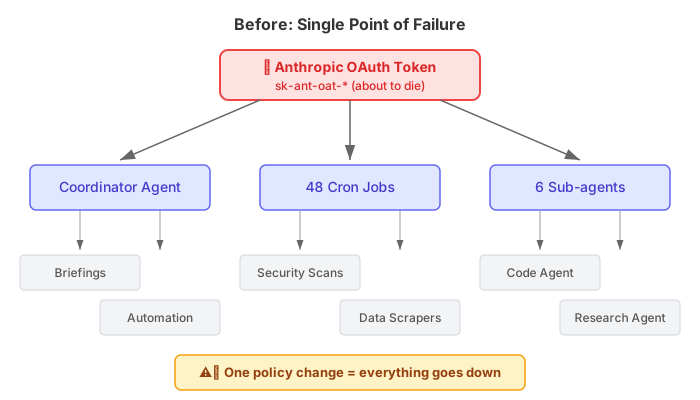
When I audited what was affected, the scope was sobering:
| System | Count | Impact |
|---|---|---|
| Cron jobs | 48 | Security scans, content pipelines, data scrapers, health monitors |
| Sub-agents | 6 | Code, content, research, security, maintenance, finance |
| Daily operations | 5+ | Morning briefings, backups, blog publishing, monitoring |
| Chat sessions | All | Primary interface for coordination |
All routing through a single OAuth token. One policy change, and everything stops.
🔄 The Pivot: Why OpenAI, Not Just a New Anthropic Key
The obvious fix: get a direct Anthropic API key from console.anthropic.com. That works. But it doesn’t solve the underlying problem — you’re still locked to one provider.
OpenAI still supports OAuth for third-party tools. That means OpenClaw can authenticate via OpenAI without the same restriction Anthropic just introduced. More importantly, OpenAI’s model lineup covers the full spectrum I need:
| Role | Anthropic (old) | OpenAI (new) | Notes |
|---|---|---|---|
| Deep reasoning | Claude Opus | GPT-4o / o3 | Strategic analysis, security audits |
| Daily workhorse | Claude Sonnet | GPT-4o-mini | Blog drafts, code review, content |
| Routine crons | Claude Haiku | GPT-4o-mini | Health checks, scrapers, briefings |
| Long context | — | GPT-4o (128K) | Large document processing |
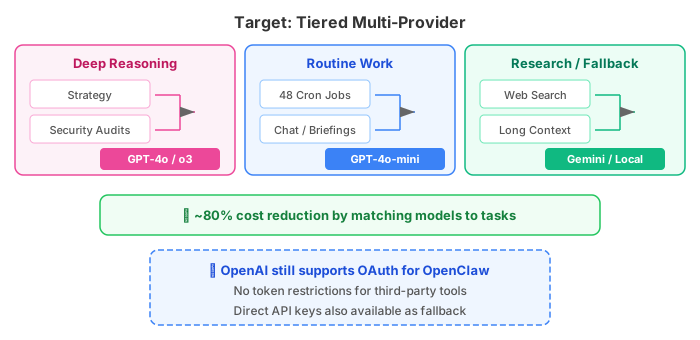
The cost picture also changes significantly:
| Task | Anthropic Cost | OpenAI Cost | Savings |
|---|---|---|---|
| Morning briefing | ~$0.15/run | ~$0.01/run | 93% |
| Security scan | ~$0.20/run | ~$0.08/run | 60% |
| Blog draft | ~$0.30/run | ~$0.04/run | 87% |
| Cron health check | ~$0.10/run | ~$0.005/run | 95% |
| 48 crons/day | ~$5-8/day | ~$0.80-1.50/day | ~80% |
📋 The Migration: Step by Step
1. Full Backup First
Before touching anything:
# Snapshot everything
tar -czvf backup-pre-migration.tar.gz \
    ~/.openclaw/ \
    ~/workspace/ \
    ~/projects/

# Store offsite
rclone copy backup-pre-migration.tar.gz remote:backups/
Rule: No credential change without a rollback plan. Ever.
2. Set Up OpenAI Access
# Store the new API key
pass insert openai/api-key

# OpenClaw supports multiple providers — configure OpenAI
openclaw config set providers.openai.apiKey "$(pass openai/api-key)"
openclaw config set defaultModel "openai/gpt-4o"
OpenClaw’s provider abstraction means the actual swap is configuration, not code. The agent prompts, cron definitions, and memory files don’t change.
3. The Gateway Swap
# Restart with new provider
openclaw gateway restart

# Verify connection
openclaw gateway status
# Should show: connected, model: openai/gpt-4o
Total downtime: under 2 minutes.
4. Tiered Model Assignment
This is where the migration becomes an upgrade. Instead of running everything on one model, I assigned models by task complexity:
# Heavy reasoning stays on the best available
openclaw cron edit security-scan --model "openai/gpt-4o"
openclaw cron edit strategic-review --model "openai/gpt-4o"

# Routine work goes to the fast, cheap model
openclaw cron edit morning-briefing --model "openai/gpt-4o-mini"
openclaw cron edit health-check --model "openai/gpt-4o-mini"
openclaw cron edit data-scraper --model "openai/gpt-4o-mini"
5. Verification Sweep
# Check all crons ran successfully post-migration
openclaw cron list --status

# Monitor for 24h — watch for silent failures
openclaw cron list --failed --since 24h
48 crons means 48 things that could silently break. I tested 5 representative jobs first, then batch-migrated the rest.
🏗️ Future-Proofing: The Multi-Provider Architecture
The real win isn’t switching from Anthropic to OpenAI. It’s building an architecture where the next provider change is a non-event.
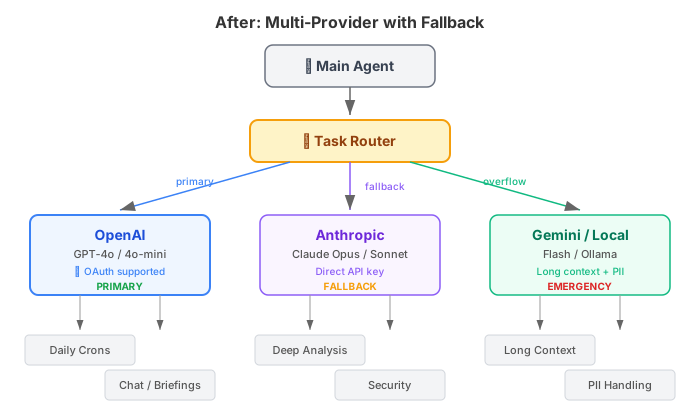
The key design principles:
1. Provider abstraction. OpenClaw handles this natively — agents don’t know or care which provider they’re talking to. Swap the config, not the code.
2. Tiered routing. Match the model to the task. Not everything needs the frontier model. Most cron jobs run fine on GPT-4o-mini at 1/20th the cost.
3. Fallback chains. If OpenAI is down, route to Anthropic. If both are down, fall back to local models for critical paths (backups, monitoring).
4. No single auth dependency. Keep active API keys for at least two providers at all times. Test the fallback monthly.
Here’s what the provider decision matrix looks like:
| Signal | Primary (OpenAI) | Fallback (Anthropic) | Emergency (Local) |
|---|---|---|---|
| API healthy | ✅ Route here | Standby | Standby |
| API down | Skip | ✅ Activate | Standby |
| Both down | Skip | Skip | ✅ Critical only |
| Rate limited | Throttle | ✅ Overflow | Standby |
| Cost spike | Review | ✅ Shift load | Bulk tasks |
📝 The HANDOFF.md Pattern
One thing that proved invaluable: writing a migration runbook before the crisis.
# HANDOFF.md — Provider Migration Runbook

## Trigger
Provider blocks OAuth or changes pricing/access terms.

## Pre-flight
1. Full backup (local + offsite)
2. Verify fallback provider API key is active
3. Test fallback on one non-critical cron

## Execution
1. Update provider config: openclaw config set defaultModel <new>
2. Restart gateway: openclaw gateway restart
3. Verify core: chat responds, one cron fires
4. Batch update cron models (use tiered assignment)

## Verification
- [ ] Gateway connected to new provider
- [ ] 5 representative crons pass
- [ ] Batch migrate remaining crons
- [ ] Monitor 24h for silent failures
- [ ] Update cost tracking

## Rollback
Restore from backup + restart gateway with old config.
Write the runbook when you’re calm. Execute it when you’re not.
⏰ Migration Timeline
| Phase | Time | Action | Status |
|---|---|---|---|
| Discovery | T+0h | Read Anthropic announcement | ⚡ |
| Audit | T+1h | Map all affected systems (48 crons, 6 agents) | ✅ |
| Backup | T+2h | Full snapshot — local + offsite (547MB) | ✅ |
| Runbook | T+3h | Write HANDOFF.md with step-by-step instructions | ✅ |
| OpenAI setup | T+4h | Configure API key, test on single cron | ✅ |
| Gateway swap | T+4h | Credential swap + restart (2 min downtime) | ✅ |
| Tier assignment | T+5h | Assign models to all 48 crons by complexity | ✅ |
| Monitoring | T+6-48h | Watch for silent failures, verify each cron | 🔄 |
Total active work: ~5 hours. Most of that was verification and documentation, not the actual swap.
🎯 Takeaways
If you’re running an AI agent system — whether it’s OpenClaw, LangChain, AutoGen, or something custom — here’s what I’d do differently:
-
Never single-provider. Keep active API keys for at least two providers. Test the fallback monthly. The provider that works today might change terms tomorrow.
-
OpenAI still allows OAuth for tools like OpenClaw. If Anthropic’s change affects you, this is the path of least resistance. But don’t just swap one dependency for another — build the multi-provider layer while you’re at it.
-
Tier your models aggressively. I was running routine cron jobs on the most expensive model available. That’s like taking a helicopter to the corner shop. GPT-4o-mini handles 80% of my cron jobs at 5% of the cost.
-
Write the runbook before the crisis. A
HANDOFF.mdthat documents every migration step is worth its weight in gold at 3am on a Sunday. -
Backup before you touch anything. Obvious, but easy to skip when the deadline is 48 hours away. Don’t skip it.
The Anthropic OAuth change was a wake-up call. Not because Anthropic did anything wrong — providers change terms, that’s reality. The wake-up call is that I was running production infrastructure on a single authentication path with no tested fallback.
That’s the actual bug. The OAuth change just exposed it.
All 48 cron jobs are running on OpenAI. The multi-provider routing is in progress. The next time a provider changes their terms, it’ll be a config change — not an emergency.