What Factual AU's Narrative Clusters Reveal About Budget 2026 Discourse
The recurring narratives in Factual AU show how quickly scenario-dependent Budget 2026 claims get compressed into deterministic slogans.
The most interesting signal in Factual AU is no longer any single hot take about Budget 2026. It is the pattern that emerges when similar claims are clustered together.
As of 15 May 2026, the dashboard tracks 60 fact-checks, 17 recurring narratives, 11 core reference sources, and 3 scrutiny lanes in scope: negative gearing reform, CGT redesign, and claims about founder exits or startup-investment effects. When you filter the narratives view, the same shape keeps reappearing. The internet is very good at turning conditional claims into definitive slogans.
That matters because the Budget package is not simple. Some parts are explicit and mechanical. Others depend on timing, asset type, inflation, marginal tax rates, business structure, concession eligibility, housing supply, and investor behaviour. But online debate tends to flatten all of that into lines like “founders will leave”, “young Australians are the real losers”, or “this budget punishes aspiration”.
The Distribution Is the Story
Across the current local corpus, the verdict distribution is:
- 57 supported
- 58 requires assumptions
- 26 rhetorical
- 17 unsupported
That is the first clue that the debate is not mainly suffering from simple factual error. It is suffering from compression. A large share of the claims are not false in the cleanest sense. They are missing the assumptions that would make them meaningful.
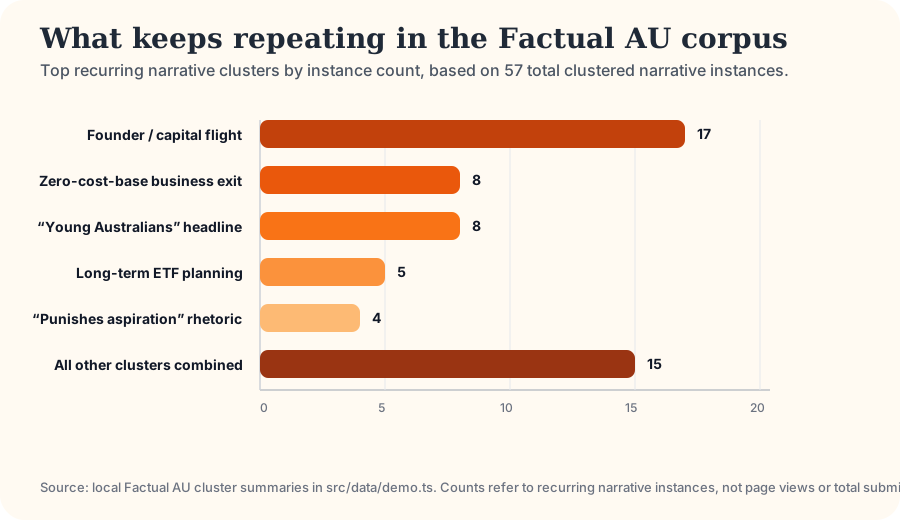
Caption: The largest clusters are not the cleanest claims. They are the ones that package uncertainty into crisp, emotionally legible narratives.
The biggest recurring narrative cluster is founder-capital-flight, with 17 instances and an aggregate verdict of requires assumptions. The second-largest high-friction cluster is zero-cost-base-business-exit, with 8 instances, also requires assumptions. Another 8-instance cluster, young-australians, lands unsupported. Then there is long-term-etf-planning with 5 requires_assumptions and aspiration-budget with 4 rhetorical instances.
That ranking tells you something important. The dominant narratives are not narrow disagreements about statutory wording. They are claims about what people will do next, who will ultimately bear the cost, and what the package means morally.
What the Official Material Actually Settles
The official Budget 2026 tax reform page does settle several core mechanics. It says the government will replace the 50% CGT discount with an inflation-based discount plus a minimum 30% tax on gains from 1 July 2027. It also says negative gearing will be limited to new builds from 1 July 2027.
Most importantly for the housing debate, the page says: “Existing arrangements will remain unchanged for all properties held before Budget night.”
That is not a small detail. It is one of the reasons so many broad generational claims become unstable on inspection. The policy is not a uniform reset. It has transition rules, grandfathering, and different treatment for established housing versus new builds.
The same official page also says investors who buy established housing after Budget night can still deduct losses against residential property income, can carry forward unused losses, but cannot deduct those losses against wages. And the broader package is not purely restrictive: the government also says venture capital incentives will be expanded from 1 July 2027, alongside other startup-support measures elsewhere in the package.
Once you absorb those mechanics, a lot of online certainty starts looking premature.
Why “Requires Assumptions” Dominates
Take the founder-capital-flight cluster. Its recurring headline is simple: remove the CGT discount and founders or capital will leave Australia. That may happen in some cases. But it is not established by the policy text alone.
To get from tax reform to founder exodus, you have to assume that tax is the dominant location variable, that other startup conditions do not offset the hit, that expanded venture capital incentives do not matter much, and that no later founder-specific carve-out changes the outcome. Those are not crazy assumptions. They are just still assumptions.
The same pattern shows up in zero-cost-base-business-exit. The slogan version is that a self-funded founder will now automatically lose 47% on exit. But the local corpus repeatedly finds that this depends on who owns the asset, what their marginal rate is, whether small-business CGT concessions apply, how the cost base is characterised, and what part of the gain accrues after July 2027. “Automatic” does a lot of hidden work there.
ABC’s startup backlash coverage captures the emotional intensity of that response. One warning quoted there was: “We risk repeating the disastrous 2009 Employee Share Option Plan.”
That is exactly the sort of line that spreads online because it is vivid, historically loaded, and easy to remember. It is also a perfect example of the difference between a politically potent warning and a fully established factual conclusion.
The long-term-etf-planning cluster works the same way in a different register. The factual part is real: listed shares remain in scope, and long-horizon savers may face different after-tax outcomes under an inflation-based system with a 30% floor. But whether long-term ETF investors are “almost certainly worse off” depends on inflation, return paths, holding periods, tax brackets, and what counterfactual is being used. The claim becomes much weaker once those inputs are surfaced.
Unsupported Does Not Mean Harmless
The young-australians cluster is worth watching because it lands unsupported rather than merely conditional. This narrative usually claims that the current CGT discount mainly protects younger Australians trying to build wealth.
That story is emotionally plausible. It fits the tone of a lot of social posts. It also clashes with the distributional picture cited in both public-policy analysis and media coverage. As Guardian Australia reported, “The top 10% of income earners receive nearly 90% of the benefit of the CGT.”
That does not mean every younger saver is unaffected. It means the broad claim about who mainly benefits from the current concession is not supported by the available source base.
There is a similar pattern in the smaller unsupported cluster claiming Australia is now the most punitive developed-country tax regime for founders. That may be a useful argument for a founder-specific relief proposal. It is not, on the current corpus, a settled cross-country fact.
Rhetoric Is Doing Real Work Too
The aspiration-budget cluster lands as rhetorical, not because it is trivial, but because it is really a statement about values. “This budget punishes aspiration” is not a cleanly verifiable proposition in the way an effective date or grandfathering rule is.
That is true even when the rhetoric is anchored to a real policy change.
You can see the same gap in housing commentary. The ABC explainer makes clear that old and new rules split at Budget night, with new homes exempt from the negative gearing restriction and future gains moving into the post-July-2027 CGT regime. That is policy architecture. Whether the package therefore “destroys ambition” or “saves aspiration” is interpretation layered on top.
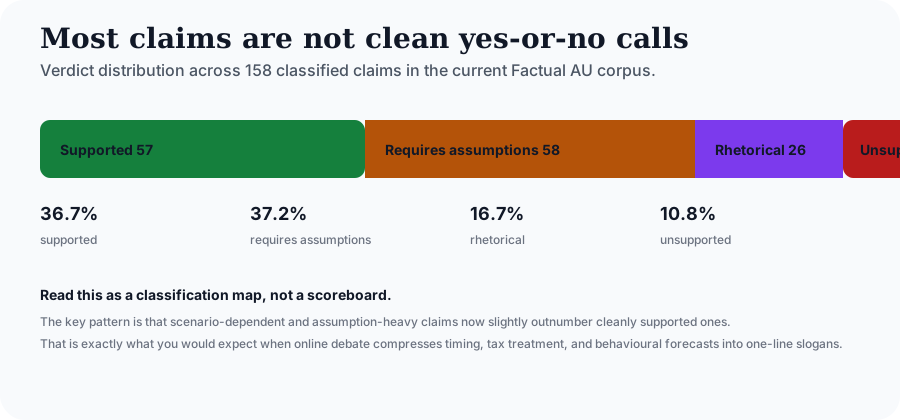
Caption: The verdict mix is unusually revealing. “Requires assumptions” slightly exceeds “supported”, which suggests the discourse problem is less about raw fabrication than about missing conditionality.
Guardian’s reporting on Treasury modelling sharpens that point further. The estimated effects are not nothing, but they are also not apocalyptic in a one-directional way: property values grow about 2% less for a couple of years, around 75,000 extra homeowners are expected over a decade, around 35,000 fewer homes may be built, and rents are estimated at roughly $2 a week higher. That is the opposite of a one-line story. It is a trade-off profile.
The Deeper Pattern
What the narrative distribution reveals is that online policy discourse has a strong preference for claims that feel mechanically inevitable even when the underlying system is conditional.
If a claim needs five assumptions, social media strips away four of them.
If a policy has different effects across existing property owners, new-build investors, share investors, zero-cost-base founders, and founders eligible for concessions, the public narrative will often collapse those cases into a single identity story.
If the official package contains both a harder tax treatment in one lane and support measures in another, debate will usually treat one side as the whole package.
That is why a tool like Factual AU is useful even when it does not produce a dramatic “false” verdict every time. The value is often in showing where a claim stopped being a clean description and became a scenario prediction, a moral summary, or a distributional overreach.
Budget 2026 discourse is full of those moves. The recurring clusters make them visible.
And that, more than any individual hot take, is the real map of the debate.